Paul Revere’s Midnight Ride: A Comprehensive Overview

Numerous digital resources offer “Paul Revere’s Ride” in PDF format, including educational materials and the complete poem by Longfellow.
These readily available documents
facilitate study and deeper understanding of this pivotal historical event.
Historical Context of the Ride
The year 1775 marked a critical juncture in the escalating tensions between Great Britain and its American colonies. Years of restrictive policies, taxation without representation, and growing colonial discontent had fostered a climate ripe for rebellion. British military presence in Boston was substantial, intended to enforce parliamentary authority and suppress burgeoning dissent.
This period witnessed the rise of clandestine communication networks, notably the Committees of Correspondence, which facilitated the exchange of information and coordinated resistance efforts among the colonies; Paul Revere’s ride occurred within this framework of organized opposition. The British planned a march to Concord to seize colonial arms and ammunition, prompting the need for a swift warning system.
The events of April 18th were not isolated; they were the culmination of years of political and economic friction. Understanding this broader historical context is crucial to appreciating the significance of Revere’s actions and the subsequent outbreak of the Revolutionary War. Digital resources, often available as PDFs, detail this complex backdrop, offering comprehensive insights into the era.
The Poem by Henry Wadsworth Longfellow
Published in 1860, “Paul Revere’s Ride” is a narrative poem by Henry Wadsworth Longfellow that dramatically recounts the events of April 18, 1775. While celebrated for its evocative imagery and patriotic fervor, the poem takes considerable liberties with historical accuracy, embellishing Revere’s role and simplifying the complexities of the warning system.
Longfellow’s work quickly became immensely popular, solidifying Revere’s place in American folklore as a lone hero bravely alerting the countryside. The poem’s rhythmic structure and memorable verses contributed to its widespread dissemination and enduring appeal. Numerous editions of the poem, including those in PDF format, are readily accessible today, allowing readers to experience Longfellow’s lyrical interpretation of this historical event.
Despite its inaccuracies, the poem served to galvanize national sentiment during the Civil War era, promoting ideals of courage, liberty, and self-sacrifice. It remains a cornerstone of American literary heritage, frequently studied in schools and cherished for its poetic qualities.
Accuracy and Inaccuracies in Longfellow’s Depiction
While Longfellow’s “Paul Revere’s Ride” is a powerful piece of American literature, it significantly deviates from historical fact. The poem portrays Revere as the sole rider alerting the colonists, neglecting the crucial contributions of William Dawes and Samuel Prescott. Revere was indeed one of several individuals tasked with warning the countryside, but he wasn’t the only one.
Furthermore, the poem exaggerates the extent of Revere’s ride; he was captured by British patrols before reaching Concord, and Prescott ultimately completed the mission of warning the town. PDF versions of scholarly articles and historical analyses readily available online detail these discrepancies, offering a more nuanced understanding of the event.
Longfellow prioritized poetic license over strict historical fidelity, aiming to create a compelling narrative that embodied American ideals. Despite these inaccuracies, the poem’s enduring legacy lies in its ability to inspire patriotism and commemorate the spirit of the Revolution.
Paul Revere’s Life Before the Ride
Before becoming immortalized for his midnight ride, Paul Revere was a well-established and respected figure in Boston society. Born in 1735, he followed in his father’s footsteps, becoming a skilled silversmith – a trade that provided him with both financial stability and a network of contacts throughout the colonies.
Revere’s life wasn’t solely dedicated to craftsmanship; he was deeply involved in the political currents of the time. He actively participated in the Sons of Liberty, a secret society formed to protest British policies, and became a key figure in the growing resistance movement. PDF documents detailing colonial Boston life showcase the interconnectedness of tradesmen and political activism.
His expertise extended beyond silverwork; Revere was also a proficient engraver, creating political cartoons and prints that fueled anti-British sentiment. This combination of skills and connections positioned him perfectly to serve as a messenger and organizer during the escalating tensions leading up to the Revolutionary War.
Revere’s Occupation as a Silversmith
Paul Revere’s primary occupation was that of a highly skilled silversmith, a craft he learned from his father, Apollos Revere. He inherited the family business in 1754 and quickly established himself as a prominent artisan in Boston. His work encompassed a wide range of silver objects, including teapots, bowls, tankards, and buckles, catering to a diverse clientele.
The silversmith trade wasn’t merely about artistic creation; it was a vital part of the colonial economy and social fabric. Revere’s shop served as a hub for news and information, connecting him to a broad network of individuals. PDF resources on colonial crafts highlight the importance of silversmiths in community life.
His meticulous craftsmanship and business acumen allowed him to thrive, even amidst the political turmoil of the 1760s and 70s. The income from his silversmithing provided him with the financial independence to dedicate time to his political activities and ultimately, to his role as a messenger during the critical events of April 1775.
The Boston Tea Party and Revere’s Involvement
Paul Revere was deeply involved in the events leading up to and including the Boston Tea Party in December 1773. While not a primary organizer, he actively participated as a member of the Sons of Liberty, a secret revolutionary organization. He served as a messenger, utilizing his network and skills as a silversmith to communicate with fellow patriots throughout Massachusetts.
Revere’s role involved delivering information about British troop movements and plans, crucial for coordinating resistance efforts. He created and distributed engravings depicting the Tea Party, serving as powerful propaganda to rally support for the colonial cause. These images, often found in PDF collections of Revolutionary War era prints, helped shape public opinion.
The Tea Party significantly escalated tensions with Britain, pushing the colonies closer to armed conflict. Revere’s commitment to the cause, demonstrated through his active participation and dissemination of information, solidified his position as a key figure in the burgeoning revolutionary movement. His actions foreshadowed his later, more famous ride.
The Growing Tensions Between Britain and the Colonies
Throughout the 1760s and early 1770s, a palpable increase in tensions characterized the relationship between Great Britain and its American colonies. British policies, enacted after the French and Indian War, aimed to exert greater control and extract revenue from the colonies, sparking widespread resentment.
Acts like the Stamp Act and the Townshend Acts, imposing taxes without colonial representation, fueled the cry of “No taxation without representation!” Colonial resistance manifested in boycotts, protests, and the formation of groups like the Sons of Liberty. These escalating conflicts are often documented in PDF archives of historical documents.
The British response, often involving increased military presence and stricter enforcement of laws, further inflamed colonial anger. This cycle of action and reaction created a volatile atmosphere, pushing the colonies towards a breaking point. The seeds of revolution were sown, setting the stage for events like Paul Revere’s ride and the subsequent battles.
British Military Presence in Boston
By 1775, Boston was heavily occupied by British troops, a direct consequence of escalating tensions with the colonies. The British government, concerned about colonial unrest and resistance to its policies, dispatched soldiers to maintain order and enforce its authority. This military presence was perceived by many colonists as an oppressive occupation, a constant reminder of British control.
The arrival of British regulars, often referred to as “lobsterbacks” by the colonists, heightened anxieties and fueled resentment. Frequent clashes between soldiers and civilians, such as the Boston Massacre in 1770, further exacerbated the situation. Detailed accounts of this period, including troop movements and colonial reactions, are often found within PDF collections of historical records.
This heightened military presence served as a catalyst for colonial organization and preparedness, including the establishment of local militias and communication networks – crucial elements leading up to Paul Revere’s famous ride. The British actions inadvertently accelerated the march towards revolution.
The Role of the Committees of Correspondence
Established in the years leading up to the Revolutionary War, the Committees of Correspondence were instrumental in fostering colonial unity and disseminating information. These networks, initially formed in Massachusetts, quickly spread throughout the colonies, enabling rapid communication about British actions and colonial grievances. They served as a shadow government, coordinating resistance efforts.
The committees facilitated the exchange of letters, pamphlets, and other materials, keeping colonists informed about events in other regions. This widespread communication was vital in building a shared sense of identity and purpose. Many primary source documents detailing the activities of these committees are now available in digitized PDF formats, offering valuable insights.
Crucially, the Committees of Correspondence played a direct role in preparing for the British advance in April 1775, including organizing the warning system that Paul Revere utilized during his midnight ride. Their pre-existing network was essential for quickly alerting militias and preparing for potential conflict.
Planning the Warning System
Recognizing the potential for British military action, colonial leaders proactively developed a sophisticated warning system to alert militias and patriots. This system relied heavily on a network of riders, strategically positioned to quickly disseminate information across the countryside. Detailed plans, often documented in correspondence now available in PDF format, outlined routes and communication protocols.
The system wasn’t solely reliant on horseback riders; it incorporated visual signals, most notably the lanterns in the Old North Church. This multi-faceted approach ensured redundancy and increased the likelihood of a successful warning. The planning involved identifying key individuals, like Paul Revere, William Dawes, and Samuel Prescott, prepared to undertake the perilous ride.
These preparations were born from the Committees of Correspondence’s efforts to organize and mobilize colonial resistance. The efficiency of the warning system directly contributed to the colonists’ ability to confront the British at Lexington and Concord, demonstrating the foresight and dedication of those involved.
The Signal System: Lanterns in the Old North Church
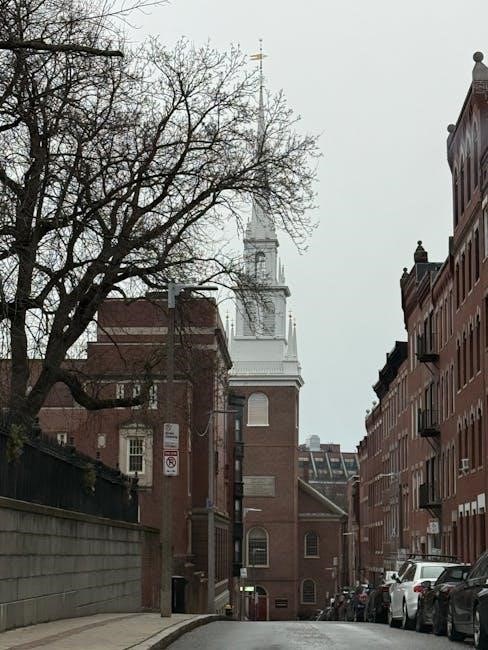
A crucial component of the warning system was the pre-arranged signal utilizing lanterns hung in the steeple of Boston’s Old North Church. This visual communication method, detailed in historical accounts often found in PDF documents, was designed to convey the British troop movement direction. One lantern signified the British were advancing “by land,” while two lanterns indicated movement “by sea” across the Charles River.
Robert Newman, the church sexton, bravely undertook the task of displaying the lanterns, risking severe consequences if discovered by British authorities. This simple yet effective signal allowed observers in Charlestown to quickly relay the information to waiting riders, including Paul Revere. The clarity of the signal was paramount, ensuring accurate and timely warnings.
The lantern signal, immortalized in Longfellow’s poem, became a potent symbol of colonial defiance and ingenuity. While the poem romanticizes the event, the core function of the signal – rapid communication – was vital to the success of the warning system and the subsequent events at Lexington and Concord.
One if by Land, Two if by Sea: Decoding the Signal
The iconic phrase, “One if by land, two if by sea,” encapsulates the simplicity and effectiveness of the signal system employed on the night of April 18, 1775. This pre-arranged code, frequently detailed in PDF resources about Paul Revere’s ride, was crucial for alerting colonists to the British army’s intended route of march. Understanding this code was paramount for those tasked with spreading the alarm.
The signal, observed from across the Charles River in Charlestown, instantly communicated whether the British were planning to cross the land route via Boston Neck or to embark on boats for Cambridge or Charlestown. This immediate knowledge allowed riders like Paul Revere to choose the most efficient path to warn the countryside.
Longfellow’s poem dramatically popularized this phrase, cementing it in American folklore. However, the underlying principle – a clear, concise signal for rapid communication – was a practical necessity born of the urgent need to prepare for the British advance. PDF analyses often highlight the signal’s strategic importance.
The Start of the Ride: April 18, 1775
The evening of April 18, 1775, marked the commencement of Paul Revere’s famed ride, a pivotal moment extensively documented in numerous PDF resources detailing the events leading up to the American Revolution. Revere’s mission began after receiving confirmation that the British troops were preparing to march from Boston.
He was dispatched by Dr. Joseph Warren and the Boston Committee of Correspondence, tasked with alerting colonists in Lexington and Concord of the impending British movement. This initial stage of the ride involved a clandestine crossing of the Charles River, avoiding British patrols and warships.
PDF analyses of the ride often emphasize the secrecy surrounding its start, highlighting the risks Revere undertook. He didn’t ride alone initially, coordinating with others to maximize the reach of the warning. The urgency of the situation demanded swift and discreet action, setting the stage for a night of daring and patriotic fervor, as immortalized in Longfellow’s poem and countless historical accounts available in PDF format.
Revere’s Route and Fellow Riders
Paul Revere’s route wasn’t a solitary endeavor; detailed maps and accounts in PDF format illustrate a network of riders working to spread the alarm. After crossing the Charles River, Revere initially headed towards Lexington to warn John Hancock and Samuel Adams. PDF analyses reveal his path wasn’t direct, utilizing back roads and avoiding main thoroughfares to evade British detection.
Crucially, Revere wasn’t alone. William Dawes set off from Boston via the Boston Neck, taking a different route to alert colonists further south. Samuel Prescott joined them later, contributing to the widespread warning system. These collaborative efforts are thoroughly documented in historical PDFs.
The ride wasn’t a continuous gallop; riders frequently stopped to alert local militia and spread the word. PDF resources emphasize the importance of this relay system, ensuring the message reached as many colonists as possible. The combined efforts of Revere, Dawes, and Prescott, as detailed in numerous PDF analyses, were vital in preparing the colonists for the battles at Lexington and Concord.
William Dawes and Samuel Prescott
PDF documents detailing the events of April 18, 1775, reveal William Dawes embarked on his ride from Boston shortly after Revere, taking a southern route via the Boston Neck. His contribution is often overshadowed, yet crucial to alerting colonists outside of Revere’s immediate path. Historical PDFs highlight Dawes’ bravery and dedication to the cause.
Samuel Prescott, a physician, joined Revere and Dawes after they rendezvoused. When Revere was captured by a British patrol, Dawes and Prescott attempted to escape. Dawes was also captured, but Prescott successfully evaded the British and continued the warning to Concord. PDF analyses emphasize Prescott’s vital role in ensuring the message reached its destination.
These accounts, readily available in PDF format, demonstrate the collaborative nature of the warning system. While Revere’s name is most famous, the success of alerting the colonists depended on the combined efforts of Dawes and Prescott. PDFs offer detailed maps illustrating their routes and the areas they warned, providing a comprehensive understanding of their contributions.
The Capture of Revere and the Continuation of the Warning
PDF historical records detail that Paul Revere didn’t complete his intended journey to Concord. He was apprehended by a British patrol near Lincoln, Massachusetts, while en route. Accounts within these PDFs clarify that his capture didn’t halt the warning; rather, it shifted the responsibility to others.
Despite being detained, Revere was quickly released after being questioned, as he wasn’t carrying incriminating documents. However, the British confiscated his horse, preventing him from continuing. PDFs emphasize that his primary purpose – alerting the countryside – had already been largely achieved before his capture.
Crucially, William Dawes and Samuel Prescott, who were riding separate routes, continued to spread the alarm. PDFs illustrate how Prescott, successfully evading capture, rode on to Concord, delivering the vital news of the approaching British troops. These documents highlight the resilience of the warning system and the courage of those involved, ensuring the colonists were prepared for the battles ahead.
The Impact of the Ride on the Battles of Lexington and Concord
PDF analyses of the Revolutionary War consistently demonstrate that Revere’s ride, and the subsequent warnings, were instrumental in preparing the colonial militia. The advance notice allowed local minutemen to assemble at Lexington and Concord, ready to confront the British troops on April 19, 1775.
Historical PDFs reveal that the colonists, though outnumbered, were able to mount a defense due to the prior warning. This initial resistance at Lexington and Concord, while resulting in colonial casualties, significantly delayed the British advance and inflicted casualties of their own.
Furthermore, PDFs emphasize that the battles served as a catalyst, galvanizing colonial resistance and ultimately contributing to the decision to declare independence. The successful, albeit costly, defense demonstrated the colonists’ willingness to fight for their liberties. The ride’s impact extended beyond the immediate battles, shaping the course of the American Revolution and solidifying Revere’s place in history.
Longfellow’s Poem: Literary Analysis
PDF versions of “Paul Revere’s Ride” facilitate detailed literary analysis, revealing Longfellow’s masterful use of rhythm and rhyme to create a captivating narrative. The poem’s galloping meter mimics the urgency of Revere’s journey, immersing the reader in the historical moment.

Scholarly PDFs highlight Longfellow’s romanticized portrayal of events, emphasizing his prioritization of poetic license over strict historical accuracy. While the poem immortalizes Revere, it simplifies the complex network of riders and the broader warning system.
Analysis within these PDFs often focuses on Longfellow’s use of imagery and symbolism, particularly the evocative descriptions of the night and the “phantom ship.” The poem’s enduring popularity stems from its accessibility and its powerful evocation of American patriotism. Despite its inaccuracies, the poem remains a cornerstone of American literary heritage, readily available for study in digital PDF formats.
Themes of Patriotism and Courage
PDF documents containing Longfellow’s “Paul Revere’s Ride” consistently emphasize the poem’s central themes of patriotism and courage. Revere’s actions, as depicted, embody a selfless dedication to warning fellow colonists of impending British military action, fueling a spirit of resistance.
The poem’s narrative, easily accessible in PDF format, portrays Revere not merely as a messenger, but as a symbol of American resolve against oppression. His willingness to risk capture underscores the courage required to challenge a powerful empire.
Educational PDFs often utilize the poem to illustrate the burgeoning sense of American identity and the willingness to fight for liberty. While acknowledging historical nuances, these resources highlight how Longfellow’s work cemented Revere’s place as a patriotic icon. The readily available PDF versions allow for widespread exploration of these enduring themes, inspiring continued reflection on courage and national pride.
Availability of “Paul Revere’s Ride” in PDF Format
Numerous online platforms offer “Paul Revere’s Ride” as a downloadable PDF, catering to students, educators, and enthusiasts alike. Websites dedicated to classic poetry, American history, and literature frequently host the poem in this accessible format.
Specifically, resources like online libraries and educational websites provide free PDF versions, often accompanied by study guides and analysis. Commercial platforms also sell collections including Longfellow’s work, with PDF options available for purchase.
The prevalence of PDF formats ensures compatibility across various devices, enabling convenient reading on computers, tablets, and smartphones. Search engines readily locate these PDFs using keywords like “Paul Revere’s Ride PDF” or “Longfellow poem PDF”. This widespread availability facilitates easy access to this iconic piece of American literature, promoting its continued study and appreciation.
Educational Resources and Study Guides for the Poem
A wealth of educational resources accompany Longfellow’s “Paul Revere’s Ride,” designed to enhance comprehension and critical thinking. Many websites offer detailed study guides, providing summaries, analyses of poetic devices, and historical context.
These resources often include discussion questions, vocabulary exercises, and prompts for essay writing, catering to various grade levels. Teachers frequently utilize these materials to integrate the poem into history and literature curricula.
Furthermore, downloadable PDF study guides are readily available, offering a convenient and organized approach to learning. Some resources explore the poem’s historical inaccuracies, encouraging students to compare Longfellow’s depiction with documented facts. Interactive online quizzes and lesson plans further support educators in delivering engaging and informative lessons about Paul Revere and his famous ride, fostering a deeper understanding of this pivotal moment in American history.